Showing posts with label Germany. Show all posts

Monday, 5 July 2010

Beautiful Popular Landmark Tourist Attractions in Germany

According to the German Tourism Association these eight buildings are the most visited landmark tourist attractions in Germany.


The list is for landmark buildings only and does not include places like the Black Forest or the city of Berlin or Europa-Park which in total probably see more tourists than these landmark buildings. All of these beautiful buildings are popular tourist attractions in Germany today and all have fascinating rich histories and are well worth seeing by anyone traveling to Germany. Indeed a trip to Germany will not be complete for tourists without seeing these beautiful landmark tourist attractions.

Cologne Cathedral 
 
The beautiful Cologne Cathedral is visited by over 7 million tourists a year. That works out to an astonishing 20,000 visitors per day. Cologne Cathedral was built from 1248 to 1880 and has the 2nd tallest church spires in the world. Located in Cologne, Germany this Roman Catholic church is the 15th largest church in the world today.


The Reichstag

The Reichstag building is located in Berlin and was built from 1884 to 1894 for the purpose of housing the parliament of Germany called the Reichstag. A purpose the building filled until 1933 when a fire in the building was used as an excuse by the Nazis to essentially ignore and override the Reichstag or Parliament of Germany. After the fire the Reichstag building became a ruin until it was repaired in 1961-1964 and then renovated to its present glorious form in 1992. When the Berlin Wall fell and the the country of Germany was unified in 1990 the unification ceremony was held at the Reichstag building which is located close to the wall in what was West Berlin. Today the magnificent Reichstag building is one of the most visited tourist attractions in Berlin.

Hofbrauhaus in Munich 

Hofbrauhaus is a large brewery or beer hall in Munich owned by the state government that receives some 1.8 million visitors per year most of whom come to the brewery building beer hall in the fall for the Oktoberfest. The original brewery building or Hofbrauhaus am Platzl dates dates back to 1607. The beer hall building was completely remodeled in 1897 and then again in 1958 and only serves its own brewed beer and is located right in the heart of Munich not far from most hotels so tourists celebrating Oktoberfest do not have to travel far while loaded up with beer.

Heidelberg Castle

Heidelberg Castle is a massive ruin of a medieval castle sitting on a hillside overlooking the city of Heidelberg in southwestern Germany. The original castle dates back to before 1200 and from that time until the 1700’s Heidelberg Castle was home to a number of kings and royalty and was often being rebuilt or destroyed depending upon who was in power and how good they were at holding off their enemies. Heidelberg Castle has been a tourist attraction for a long time at least since the 1800’s when French writer Victor Hugo fell in love with the place and wrote about its history. Today renovations are ongoing at the castle which is visited by some 3 million tourists per year. The castle is also a popular wedding spot and a magnificent architectural structure to behold.

Neuschwanstein Castle in Bavaria

Neuschwanstein Castle is a spectacular Romanesque Revival building located atop a rugged hilltop in southwestern Bavaria, Germany. The castle was built beginning in 1869 by King Ludwig II as a temple of friendship to his friend the German composer and conductor Richard Wagner whose music the king loved. King Ludwig died in 1886 having lived in the castle for only 174 days and Wagner who died in 1883 never even stepped foot in Neuschwanstein Castle. As soon as the king died the castle was opened up to tourists and at least 60 million people have visited Neuschwanstein Castle. Today some 1.3 million people visit Neuschwanstein Castle which was the inspiration for the Sleeping Beauty Castles at Disney theme parks.

Zwinger Palace in Dresden

Zwinger Palace is a magnificent German Baroque building located in the city of Dresden in eastern Germany. Zwinger Palace was built beginning in 1710 for Frederick Augustus also known as Frederick the Strong who had visited Louis XIV at the Palace of Versailles and wanted a similar palace for himself. Zwinger Palace suffered great damage during WW II but has since been rebuilt and today is a beautiful tourist attraction in Germany that draws well over 1 million visitors per year.

Fernsehturm Tower in Berlin 

The Fernsehturm Tower is a 1,207 foot high observation tower that is a very popular tourist attraction located in the center of the city of Berlin, Germany. The tower was built from 1965-1969 by the East German Communist Government as a symbol of East Berlin and a television tower. Ironically the Fernsehturm Tower became something of an embarrassment to the Communists who did not believe in religion because when the sun shines on the stainless steel dome of the tower the reflection forms a very visible cross.
Today over 1 million people a year visit the Fernsehturm Tower which has two elevators to lift the tourists up to the observation deck for fantastic views of Berlin and as far away as 26 miles on a clear day. There is also a rotating restaurant where visitors can eat with a fabulous view.

Aachen Cathedral or the Imperial Cathedral 
The Aachen Cathedral which is also called the Imperial Cathedral is a Roman Catholic church located in western Germany in the city of Aachen. Built beginning in 792 by the Emperor Charlemagne the Aachen Cathedral was renovated around 1100 and restored in 1881. When Charlemagne died in 814 his remains were placed in a vault in Aachen Cathedral with Charlemagne’s body placed sitting on a throne with a golden crown on his head and holding a scepter in his gloved hand. His remains were placed in a casket in the vault in 1215. Aachen Cathedral was the church of coronation for 30 kings and 12 queens which earned it the name of Imperial Cathedral. Today the Aachen Cathedral is a very popular tourist attraction in Germany that sees over 1 million visitors per year.


Tuesday, 8 June 2010

Travel to Berlin: Top 10 Picks

Twenty years after its post-Wall rebirth, Berlin is a scene-stealing combo of glamour and grit, teeming with top museums and galleries, grand opera and guerrilla clubs, gourmet temples and ethnic snack shacks. Whether your tastes run to posh or punk, you can sate them in Berlin.


When it comes to fashion, art, design and music, the German capital is the city to watch. A global influx of creatives has turned it into a cauldron of cultural cool reminiscent of New York in the ’80s. What draws them is Berlin’s legendary climate of tolerance, openness and experimentation infused with an edgy undercurrent that gives this ‘eternally unfinished’ city its street cred. Cheap rents don’t hurt either.

All this trendiness is a triumph for a town that’s long been in the cross-hairs of history: Berlin staged a revolution, was headquartered by fascists, bombed to bits, ripped in half and finally reunited – and that was just in the 20th century! Famous landmarks such as the Reichstag, the Brandenburg Gate, Checkpoint Charlie and what’s left of the Berlin Wall are like a virtual 3-D textbook in a city where you’ll find history staring you in the face every time you turn a corner.
Perhaps it’s because of its heavy historical burden that Berlin is throwing itself into tomorrow with such contagious energy. At times the entire city seems to be bubbling over into one huge party. Cafes are jammed at all hours, drinking is a religious rite and clubs host their scenes of frenzy and hedonism until the wee hours. Sleep? Fuhgeddaboutit!

Yet despite its often hectic pace, Berlin functions on an exquisitely human scale. Traffic flows freely, public transportation is brilliant, you can walk without fear at night, clubs have no velvet ropes and your restaurant bill would only buy you a starter back home. Come and join the party and be swept away by the riches, quirks and vibrancy of this fascinating city.

Top 10 Picks For Berlin
1.Get high at the TV Tower
Take in unbeatable 360-degree views of Berlin from the Fernsehturm, Germany's tallest structure.
The TV Tower is the tallest structure in Germany, soaring 368m above Berlin since 1969. Come early to beat the queue for the lift ride to the panorama level at 203m, where views are unbeatable on clear days. From here and the upstairs café, which makes one revolution in 30 minutes, you can easily pinpoint landmarks and study the city layout
Address: Panoramastrasse 1a, Alexanderplatz Area
Tickets: Full €8, child €4


2.Revere the Reichstag
Stand in awe of history at Germany’s political power nexus.
Just north of the Brandenburg Gate, the Reichstag has been the seat of the Bundestag (German parliament), since 1999 following a complete renovation by Lord Norman Foster. The British architect turned the 1894 building by Paul Wallot into a state-of-the-art parliamentary facility, preserving only the historical shell and adding the glistening glass dome.
The view from the top is one of the highlights of visit to Berlin, as much for the 360-degree panorama of the city as for the close-ups of the dome. From the outdoor viewing platform you can climb the spiralling ramp inside the dome itself. At the top, displays document the building's history.
The Reichstag has been the setting of numerous milestones in German history: the proclamation of the German republic, the Reichstag fire in 1933 allowing Hitler to blame the communists and seize power, the Soviet attack a dozen years later which destroyed the building, and the enactment of the reunification of Germany on 2 October 1990.
Address: Platz der Republik 1, Tiergarten, 10557
Transport: train Hauptbahnhof, bus 100

3.Visit the Checkpoint Charlie Museum 
Stand in a hot spot of the Cold War, location of the famed tower that symbolised East-West tension.
The Checkpoint Charlie Museum is all that remains of the famed tower that symbolised East-West tension during the Cold War. The tower itself was unceremoniously craned away a few months after the border reopened. In 2001, a replica guardhouse was returned to the site (the original is in the Allierten Museum in Zehlendorf).
The museum is interesting (if overpriced), with its display of ingenious devices employed in escape attempts from the former East Germany. It doesn't make it any easier to comprehend that this nondescript urban landscape was one of the critical pressure points in the global stand-off between East and West, and the scene of 80 deaths.
To the west of the museum is the East Side Gallery, a surviving chunk of the real Wall, preserved by the city authorities and decorated by local artists.

Address: Friedrichstrasse 43-45, Kreuzberg
Transport: train: Stadtmitte, train: Kochstrasse

4.Catch the art express at the Hamburger Banhhof

Admire the star-studded collection of contemporary art at this converted 19th-century train station. Berlin's premier contemporary art museum has a star-studded collection, including works by Andy Warhol, Roy Lichtenstein and Anselm Kiefer as well as an entire wing of Joseph Beuys. Occupying a cleverly converted 19th-century railway station and adjacent 300m-long warehouse, it also has great temporary exhibits, a well-stocked art bookshop and a popular café called Sarah Wiener im Hamburger Bahnhof.
Address: Invalidenstrasse 50-51, Government Quarter
Transport: train: Hauptbahnhof
Tickets: adult/under 16/concession €8/free/4, Thu last 4hr free

5.Catch a cabaret show at Bar jeder Vernunft
Flash back to Roaring Twenties glamour at this dazzling art nouveau-style tent hosting cult cabaret shows. Entertainers at this wonderful venue have a veritable cult following and shows - many with a camp or bizarre bent - are often sold out. Part of the draw is the exquisite setting: a historic Art Nouveau-style tent decked out with dazzling mirrors and booths bathed in red-velvet and candlelight. After the show, the place turns into a relaxed piano bar.
Address: Schaperstr 24, Wilmersdorf, 10719
Transport: underground rail: Spichernstr, Uhlandstr
Tickets: €14.00-€30.00

6. Spot celebrities at Cookies
Sip signature Watermelon Man cocktails and scan the crowd for celebs at this legendary midweek party palace. The seventh incarnation of this legendary midweek party palace has been cooking since January 2007, this time in a former East Berlin cinema behind the Westin Hotel. Once past the picky bouncers, it's all about dancing with friendly folk, sipping the signature Watermelon Man cocktail and scanning the crowd for celeb sightings.
Address: Friedrichstrasse 158-164, Unter Den Linden
Transport: underground rail: Französische Strasse
Tickets: full €10

7. Go tobogganing at Potsdamer Platz
Go for the ride of your life on the mobile toboggan run, or get your skates on and hit the ice rink.

8.See the awe of the Tor
Take in the famous Brandenburg Gate (Tor), a backdrop for presidential speeches, Pink Floyd concerts and World Cup soccer matches.

9.Eyeball the Wall at the East Side Gallery
Check out the longest Berlin Wall remnant, also the world's biggest outdoor canvas.

10. Queue for currywurst at Curry 36
Join legions of locals at this legendary imbiss (snackbar) for sausage with spice.

                                                                           Source: lonelyplanet

Tuesday, 11 September 2007

Black Madonnas: Medieval (and earlier); early pagan roots?

Finding Black Madonnas

As we find more, we add:

New: See our consideration about a Black Madonna at Maria Plain, Salzburg, Austria, at Austria Road Ways, Maria Plain, Black Madonna?.

Our photo failed, so we rely on a fair use thumbnail: from http://www.mariaplain.at/


Maria Plain, Black Madonna? Salzburg, Austria

As we recall, there was also a copy at Maria Plain of the Jasna Gora Black Madonna.  Someone go back.

Mariazell, Austria:  we missed seeing this one, so here is a thumbnail

Note that this site does not even mention she is black, at ://www.sacred-destinations.com/austria/mariazell-shrine-of-our-lady.htm/. This site says she was once painted black, see http://books.google.com/books?id=2L4q8sM4JysC&pg=PA401&lpg=PA401&dq=mariazell+austria+black+madonna&source=bl&ots=RmTF6K1Ljk&sig=dI-wXXSFfE0VzrPKUkAgVd0PdPE&hl=en&ei=vmy-StbxB8XQ8Qba1dWhAQ&sa=X&oi=book_result&ct=result&resnum=3#v=onepage&q=mariazell%20austria%20black%20madonna&f=false/. 

For our older list:


1.  Gdansk, Poland

Black Madonna, Church of St. Mary, Gdansk, Poland
Black Madonna at the Church of Saint Mary, Gdansk, Poland. There as another Black Madonna at that Church, that looks like a copy of the Black Madonna at Jasna Gora Monastery, also in Poland.

No further information yet.

Note that this may not be a Black
Madonna" because there is no child. The inscription looks like a Russian reference, by the script - but we are not expert on that.  See Poland Road Ways.

2. Mont St. Michel, France
/
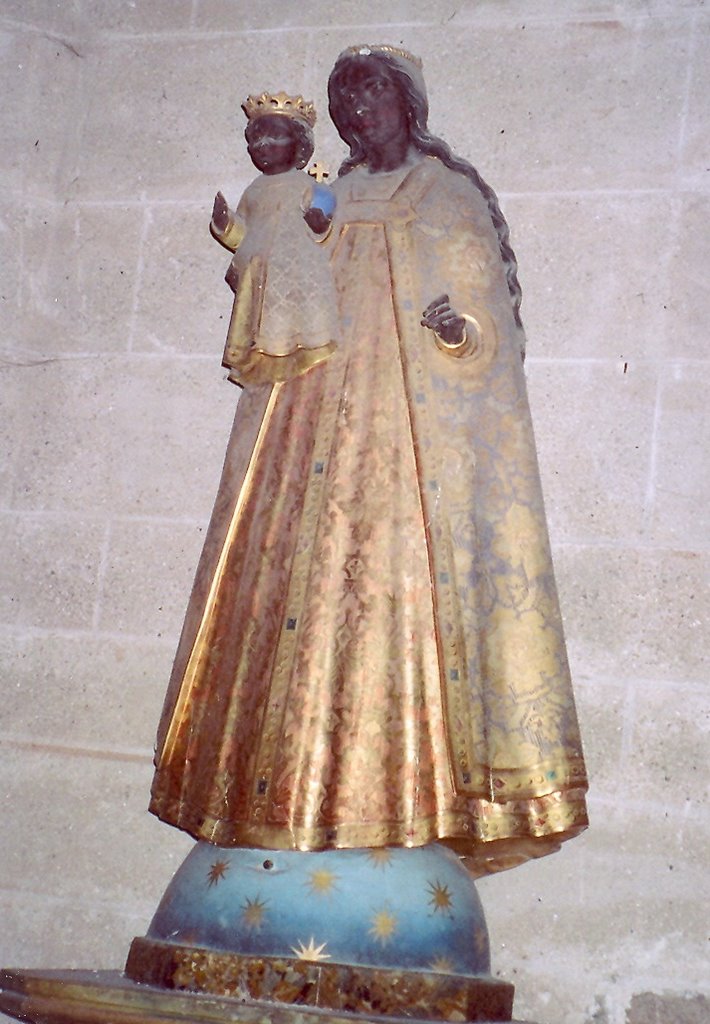
Black Madonna, Mont St. Michel, France

Black Madonnas are found throughout Europe, and seem to date from the early middle ages, mostly. Some may be earlier, and the legends and stories explaining them are varied.

For a background for these, and where they are, black virgin statues at www.ancientquest.com/embark/blackvirgin; and Eann Begg's at www.udayton.edu/mary/resources/blackm/blackm.
.
There is a theory to fit each person's predisposition as to why. No one explanation fits them all. See saxakali.com/suzar/madonna, for a history of black madonnas.

Here is the Black Madonna at Mont St. Michel, France. See if you agree that our western religious orientation is to downplay the role of the black, and lands connected to our Bible that were in Africa, see Martin Luther's Stove, Translation Serving a Cultural Agenda.

See also ://www.udayton.edu/mary/resources/blackm/blackm.

3.  Altotting, Germany

Black Madonna, Altotting, Germany
.
This is the Black Madonna at Altotting, Germany.
.
We also saw another Black Madonna at Guadalupe, Spain. This was a tiny triangular shaped Madonna with a tinier head, very high up, and with a multitude of costumes on display that change with the seasons and feast days.

These places are usually also pilgrimage destinations.  Another site names another black madonna at Altotting, see the small A-shape, doll-like form that appears in many places, at ://romanmiscellany.blogspot.com/2006/09/alttting.html/  The explanation there is that her face is darkened by the centuries - but somehow the face of the child remains light. 


4.  Jasna Gora, Czechestochowa, Poland; and Wroclaw Poland

Black Madonna, Wroclaw, Poland (copy of Jasna Gora?)
.
This is the Black Madonna at Wroclaw, Poland, apparently a copy of the original at Czestochowa, Jasna Gora Monastery, Poland. Do an "images" search for Black Madonna, Jasna Gora, and see the similarities - no photos were permitted of it.

See discussion re the broadly different representation of the Black Madonna in the Jasna Gora gift shop (different dress, and elaborate crowns, and varying skin tones available for purchase, including pale Caucasian white), at Poland Road Ways.

No one explanation fits all the Madonnas. Some charred, others originally black, others buried. This source presents the thesis that white madonnas were later in time than the black madonnas. Some find African origins. See www.africanbynature.com/links/madonnalinks.
.
Here is a picture of the small and high on the wall Black Madonna at Guadalupe, Spain. Too high for a good picture using my camera: See www.solt3.org/guadalupespain/.

5. Copy of Jasna Gora at Gdansk, Poland

Black Madonna, St. Mary's Church, Gdansk, Poland (copy of Jasna Gora)

Here is a copy of the Jasna Gora Black Madonna at Gdansk, Poland, also showing the same kind of clothing as at Wroclaw.

Even the "images" search shows some versions with the crowns and different dress, and I can't remember the original any more. I thought I was buying a picture of it, but apparently not. Someone go check it out?

This is a different concept from the "inculturated" black madonnas that reflect a cultural depiction, so that there would also be madonnas with the facial features and skin tones of the people whose conversion is sought; or ones with features like those of the faithful in the area. See www.udayton.edu/mary/meditations/blackmdn. What color was Mary? Or Jesus? What does it say about us, that we have to ask?

See this site for connections to pagan black goddesses, see crystalinks.com/blackisis.

I looked up official images of Mary at this site, catholic-forum.com/saints/saintbvm, but found none of the Black Madonnas.