Showing posts with label Spain. Show all posts

Thursday, 3 June 2010

Best beaches on the Costa Blanca, Spain

This gorgeous beach near Jávea, on Spain's Costa Blanca coast, is known as La Granadella and its seagrass beds make it perfect for snorkelling. 


Why go?
For its sheer beauty, even though it is shingly rather than sandy. The horseshoe-shaped cove with Blue Flag status has calm, sapphire water and is flanked by a dense forest of emerald Aleppo pine trees. The only problem is that it is so gorgeous it gets very crowded.

Who goes?
Spanish and European families, both tourists and residents. There is a long-standing expat population in this area, from the UK, Germany and other northern European countries.

What is there to do?
Be sure to take a snorkel and mask. The seabed falls away quite steeply from the shore, but if you swim out for 65 feet or so the shingle is replaced by sand with posidonia seagrass beds. You can also walk through the woods behind the beach, breathing in the scent of the pine trees, or up to the castle or lookout point on the cliffs.

Bars and bites
There is a shack on the beach and a few restaurants in the row of buildings behind the bay. Sur (00 34 965 771612) has lots of outdoor tables on its various terraces and serves fabulous paellas.

Getting there
The beach is between Jávea and Moraira. Head towards the Cabo de la Nao headland and take the turning down the gorge through the pine forest to La Granadella. You need to get there pretty early in the morning to get a place in the car park and avoid being stuck in a jam.
Tourist information: 00 34 966 460605, www.xabia.org


                                                                                   Source: telegraph


Sunday, 20 January 2008

Muslim Conquests - Expansion Theme, and Context

If Islamic studies, movements of culture in the Middle East, Eastern Europe, Central Europe, were not part of your schooling, go to this site for a map of the reach of early Islam - and ask why we teach as though the West is the compass point. Go to Historical Maps Overview, at Map, the Muslim World 814AD. Look at the size of Baghdad.

The roll of the Muslim territorial and religious expansion.

In no time at all, within 10 years, within a century, of the death of the Prophet in 621 AD. In that short span, the new religion had established itself firmly throughout and beyond the Arab lands of origin, and was still going, the rule then moving from the Arabs to include the Turks, and the Ottoman Empire taking over for centuries beating at Europe's doors. Europe, paying others to buffer for them (the Venetians hiring others in the Balkans, so Venice could be uninterrupted in its Empire building, for example), kept up its own religious arguments and internal and external persecutions, geneologies on thrones competing, but was there more that aided the Muslim expansion. This is not to downplay the commitment to belief that drove the movement, but to set it in a context.

Here, the Alhambra Palace, the Fountain of the Lions, at Grenada, Spain.

Black Death. Combined with local violence. Spain, Romania, the Balkans, accounts of battles against the Turks, the reign of Caliphs, what made Eastern and Central Europe so vulnerable. The role of disease and violence in history. The weakening that results, combined with lack of commitment to a relatively fixed belief system. There were differences persisting, and emerging conflicts between cultural social and religious justice-economic systems.

Here: A new book. It seems that the Black Death had a role in religious conquests as well as in other economic, social areas. Look at the speed and efficiency of the Muslim conquests after the death of the Prophet Mohammed.

To be read: "The Great Arab Conquests: How the Spread of Islam Changed the World We Live In," by Hugh Kennedy, Middleast Correspondent, The Economist, Da Cap Press 2007, see International Herald Tribune, at ://www.iht.com/articles/2008/01/04/arts/idbriefs5H.php; Steve Goddard's HistoryWire at ://www.historywire.com/2008/01/book-alert-th-1.html. Highlights from the NYT review by Max Rodenbeck:

1. Chronology provided: Unity and focus of Islam's faith, one text, virtually immediately upon the death of the Prophet Mohammed. Compare to Christianity 10-100 years after the death of Jesus, where people were still arguing over what should be in the Bible or not, "canonized" - see ://gbgm-umc.org/UMW/bible/cea.stm; in the fourth century or so; and still are discussing what happened there; and an additioal current topic - how do later writings relate, see ://www.jefflindsay.com/BOMIntro.shtml.

  • 632 AD: death of the Prophet Mohammed
  • By 647 AD: followers had "erased" Persia, decimated Byzantium's power, extended an empire's reach "as vast as that of Rome at its height.
  • By 732 AD: Muslim armies had reached China to the East, extended 5000 miles to the West, and "had charged across Spain to clash with the Merovingian princes of what is now France."

2. Scope

Military; one faith, uprooting local religions (Zoroastrianism, Buddhism, Hinduism); severing of "1000 year old links" that had bound south and north Mediterranean areas; linguistic - Arabic supplanted Latin and Greek as main conduit, "repository of human knowledge."

3. Factors primarily identified include:

Timing. "Exploitation of weakness." Plague had reduced populations in Near East and Mediterranean. "Political Turmoil" left Byzantium and Persia profoundly weakened. Areas were unprepared to counter the Muslim attacks.

Christianity was fractured - many Egyptians and Syrians sided with the Arabs against the Byzantines. Byzantines had tried to use force to convert. Muslims were more lenient, in many areas, allowing other worship, without onerous conditions (in many areas, not all). However, resistance could also be met with destruction in others.

4. Double fronts. Arab strength at outset, Turkish strength later in pushes through Balkans, East Indies, Spain. Then, stability of borders, after further upheavals several centuries later, once Spain was reconquered, and Turkish Muslims pushed back from Balkans, East Indies.

Mainly used in the book = texts, rather than archeological evidence, but we are not sure quite what that means. Waiting for the book at the library.

Tuesday, 11 September 2007

Black Madonnas: Medieval (and earlier); early pagan roots?

Finding Black Madonnas

As we find more, we add:

New: See our consideration about a Black Madonna at Maria Plain, Salzburg, Austria, at Austria Road Ways, Maria Plain, Black Madonna?.

Our photo failed, so we rely on a fair use thumbnail: from http://www.mariaplain.at/


Maria Plain, Black Madonna? Salzburg, Austria

As we recall, there was also a copy at Maria Plain of the Jasna Gora Black Madonna.  Someone go back.

Mariazell, Austria:  we missed seeing this one, so here is a thumbnail

Note that this site does not even mention she is black, at ://www.sacred-destinations.com/austria/mariazell-shrine-of-our-lady.htm/. This site says she was once painted black, see http://books.google.com/books?id=2L4q8sM4JysC&pg=PA401&lpg=PA401&dq=mariazell+austria+black+madonna&source=bl&ots=RmTF6K1Ljk&sig=dI-wXXSFfE0VzrPKUkAgVd0PdPE&hl=en&ei=vmy-StbxB8XQ8Qba1dWhAQ&sa=X&oi=book_result&ct=result&resnum=3#v=onepage&q=mariazell%20austria%20black%20madonna&f=false/. 

For our older list:


1.  Gdansk, Poland

Black Madonna, Church of St. Mary, Gdansk, Poland

Black Madonna at the Church of Saint Mary, Gdansk, Poland. There as another Black Madonna at that Church, that looks like a copy of the Black Madonna at Jasna Gora Monastery, also in Poland.

No further information yet.

Note that this may not be a Black
Madonna" because there is no child. The inscription looks like a Russian reference, by the script - but we are not expert on that.  See Poland Road Ways.

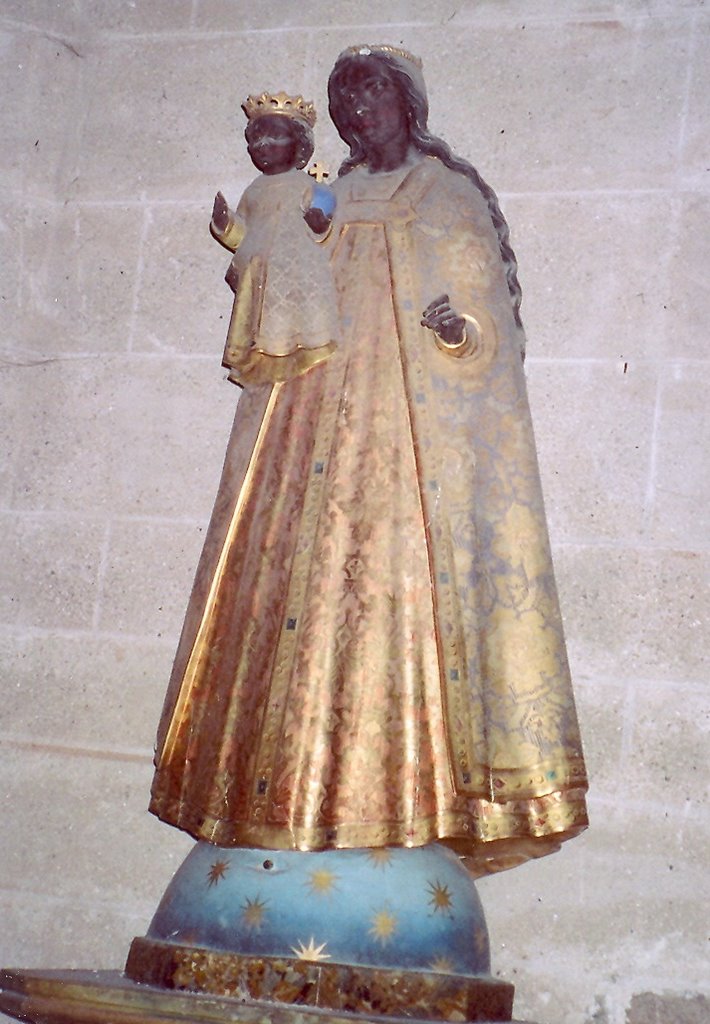
2. Mont St. Michel, France
/
Black Madonna, Mont St. Michel, France

Black Madonnas are found throughout Europe, and seem to date from the early middle ages, mostly. Some may be earlier, and the legends and stories explaining them are varied.

For a background for these, and where they are, black virgin statues at www.ancientquest.com/embark/blackvirgin; and Eann Begg's at www.udayton.edu/mary/resources/blackm/blackm.
.
There is a theory to fit each person's predisposition as to why. No one explanation fits them all. See saxakali.com/suzar/madonna, for a history of black madonnas.

Here is the Black Madonna at Mont St. Michel, France. See if you agree that our western religious orientation is to downplay the role of the black, and lands connected to our Bible that were in Africa, see Martin Luther's Stove, Translation Serving a Cultural Agenda.

See also ://www.udayton.edu/mary/resources/blackm/blackm.

3.  Altotting, Germany
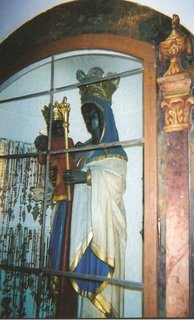
Black Madonna, Altotting, Germany
.
This is the Black Madonna at Altotting, Germany.
.
We also saw another Black Madonna at Guadalupe, Spain. This was a tiny triangular shaped Madonna with a tinier head, very high up, and with a multitude of costumes on display that change with the seasons and feast days.

These places are usually also pilgrimage destinations.  Another site names another black madonna at Altotting, see the small A-shape, doll-like form that appears in many places, at ://romanmiscellany.blogspot.com/2006/09/alttting.html/  The explanation there is that her face is darkened by the centuries - but somehow the face of the child remains light. 


4.  Jasna Gora, Czechestochowa, Poland; and Wroclaw Poland

Black Madonna, Wroclaw, Poland (copy of Jasna Gora?)
.
This is the Black Madonna at Wroclaw, Poland, apparently a copy of the original at Czestochowa, Jasna Gora Monastery, Poland. Do an "images" search for Black Madonna, Jasna Gora, and see the similarities - no photos were permitted of it.

See discussion re the broadly different representation of the Black Madonna in the Jasna Gora gift shop (different dress, and elaborate crowns, and varying skin tones available for purchase, including pale Caucasian white), at Poland Road Ways.

No one explanation fits all the Madonnas. Some charred, others originally black, others buried. This source presents the thesis that white madonnas were later in time than the black madonnas. Some find African origins. See www.africanbynature.com/links/madonnalinks.
.
Here is a picture of the small and high on the wall Black Madonna at Guadalupe, Spain. Too high for a good picture using my camera: See www.solt3.org/guadalupespain/.

5. Copy of Jasna Gora at Gdansk, Poland

Black Madonna, St. Mary's Church, Gdansk, Poland (copy of Jasna Gora)

Here is a copy of the Jasna Gora Black Madonna at Gdansk, Poland, also showing the same kind of clothing as at Wroclaw.

Even the "images" search shows some versions with the crowns and different dress, and I can't remember the original any more. I thought I was buying a picture of it, but apparently not. Someone go check it out?

This is a different concept from the "inculturated" black madonnas that reflect a cultural depiction, so that there would also be madonnas with the facial features and skin tones of the people whose conversion is sought; or ones with features like those of the faithful in the area. See www.udayton.edu/mary/meditations/blackmdn. What color was Mary? Or Jesus? What does it say about us, that we have to ask?

See this site for connections to pagan black goddesses, see crystalinks.com/blackisis.

I looked up official images of Mary at this site, catholic-forum.com/saints/saintbvm, but found none of the Black Madonnas.